
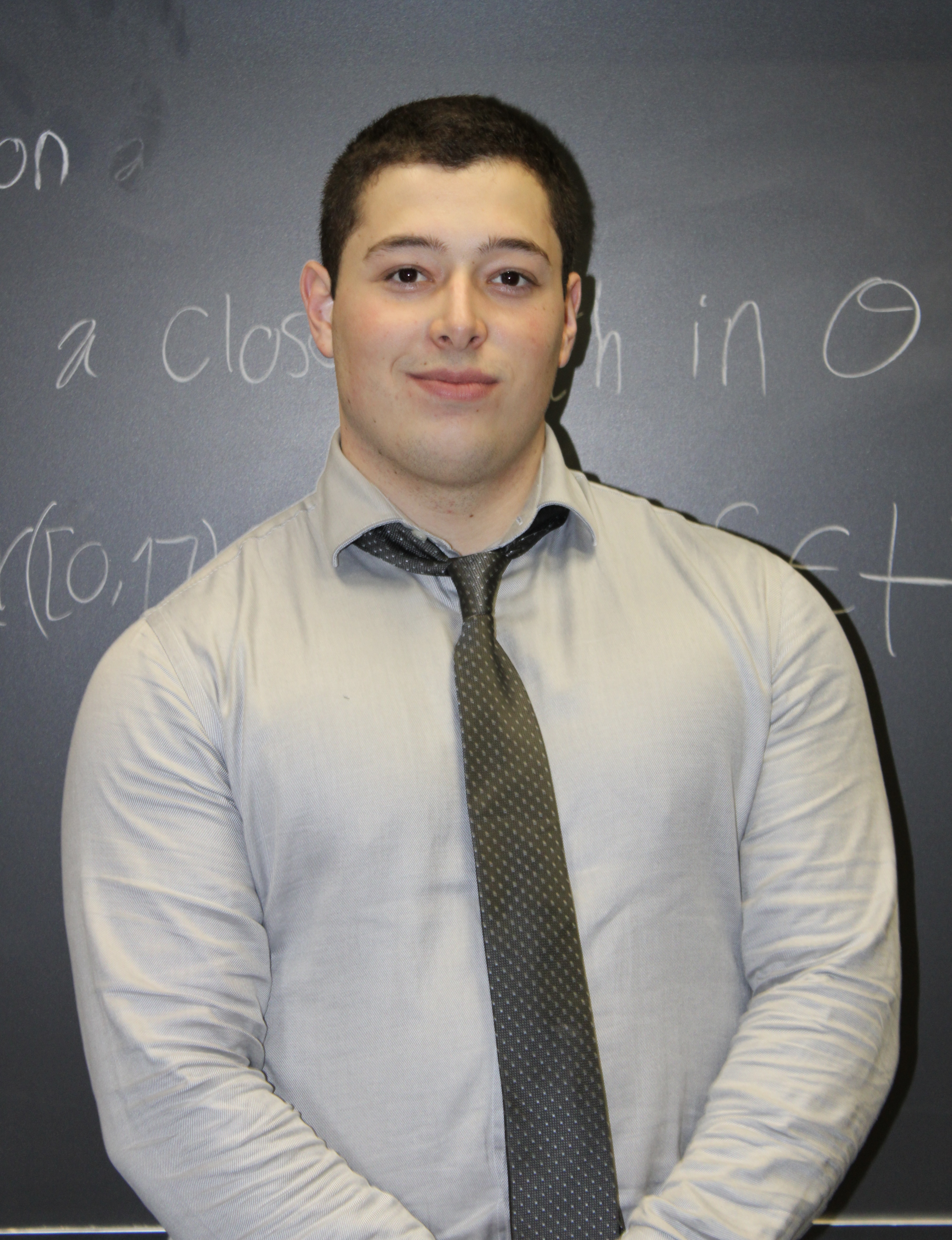
Hi, I'm Fabrizio.
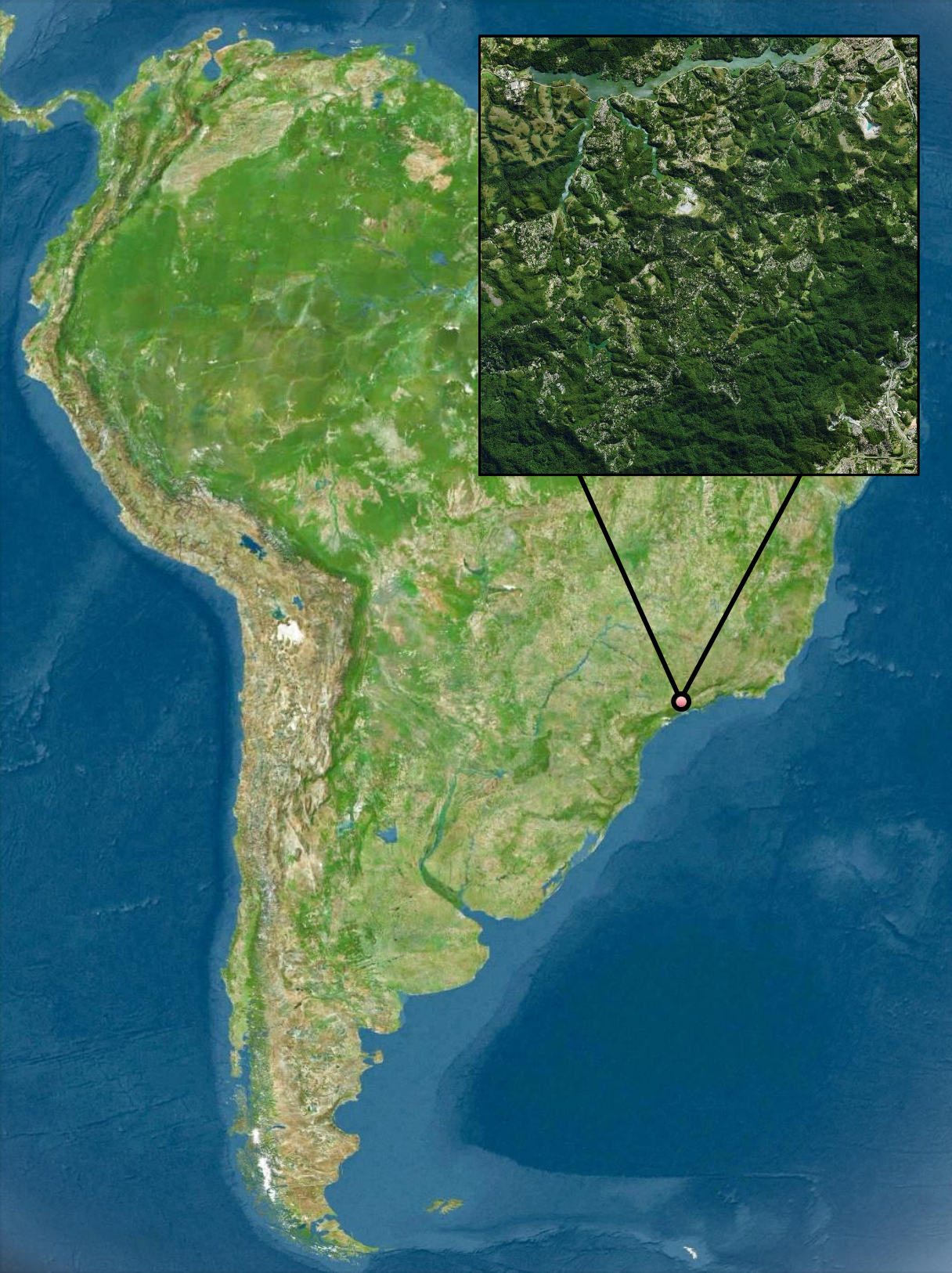
I am a MS student at the Institute of Physics of the University of São Paulo (IFUSP) with research focus in mathematical physics. I am originally from a small town in Brazil called Mairiporã, and I have a BS in Physics and Mathematics from The University of Chicago.
 More About Me
Physics and Mathematics
My main research focus is in algebraic quantum field theory in curved spacetimes. I'm also interested in Tomita-Takesaki modular theory, functional analysis, KMS states, and general relativity. During my undergraduate career, however, I've explored a wide range of different fields.
View MoreFluid Dynamics
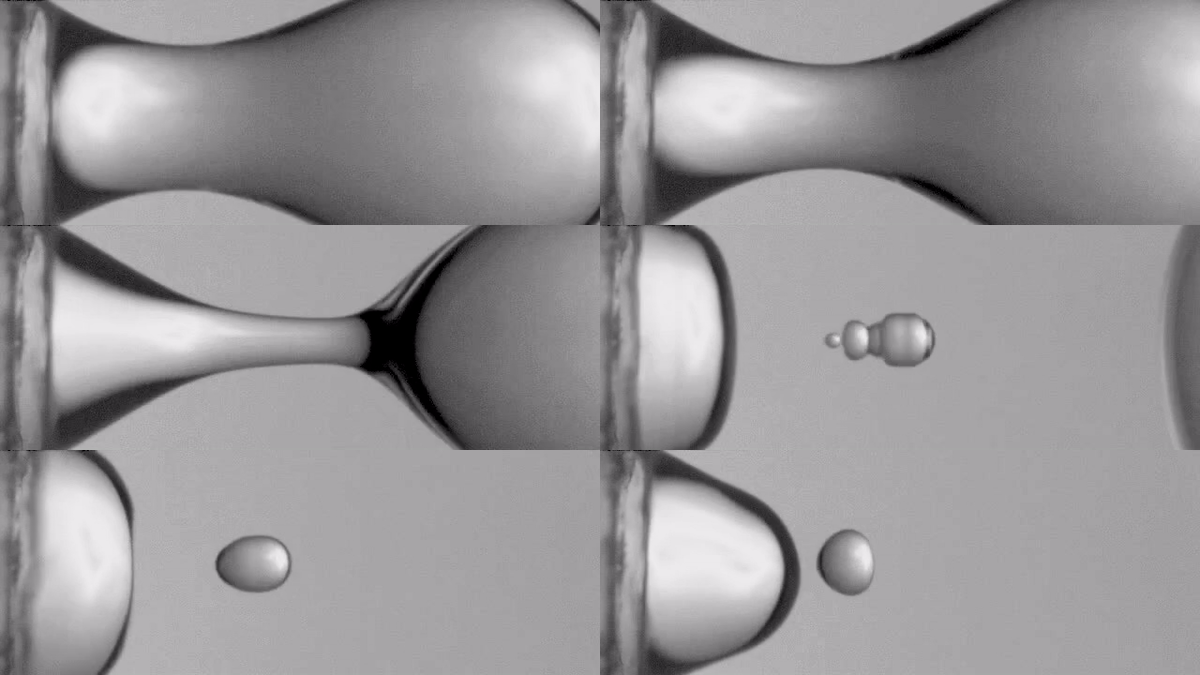
If you are ever out in the rain you may notice that water has this tendency of forming drops. The water from the rain itself comes in drops, and so does the water that falls from the leaves of a tree or the water that drips from the rooftop. This type of behavior, as a matter of fact, is not limited to water and occurs with all kinds of fluids. But why? Why does a falling stream of liquid break up into droplets and what does it look like?
Nuclear Physics
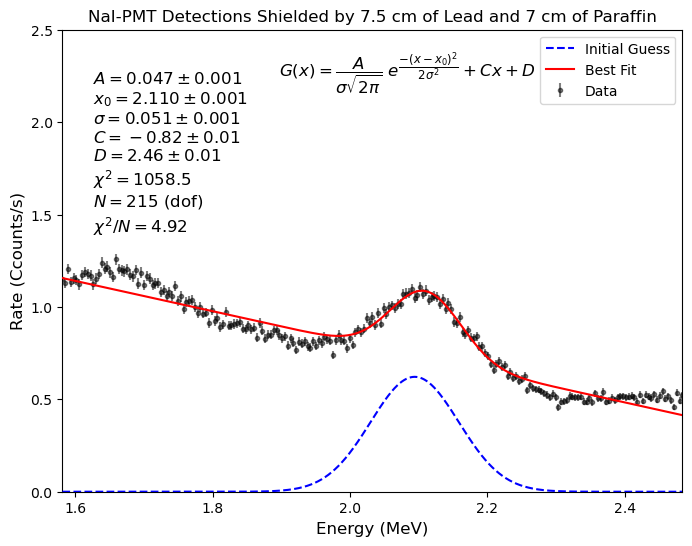
The mass of charged fundamental particles, such as protons and electrons, can be measured by sending them through a magnetic field and determining the radius of curvature of their path (this technique is known as mass spectrometry). But what if you want to measure the mass of the neutron? They are neutral particles and so they don't experience a Lorentz force. If you were to send neutrons through a magnetic field their paths wouldn't be affected at all, so mass spectrometry doesn't work for them. What do we do when things don't go our way? We smash them! In this case we smash neutrons and protons to produce deuteron.
Observational Cosmology
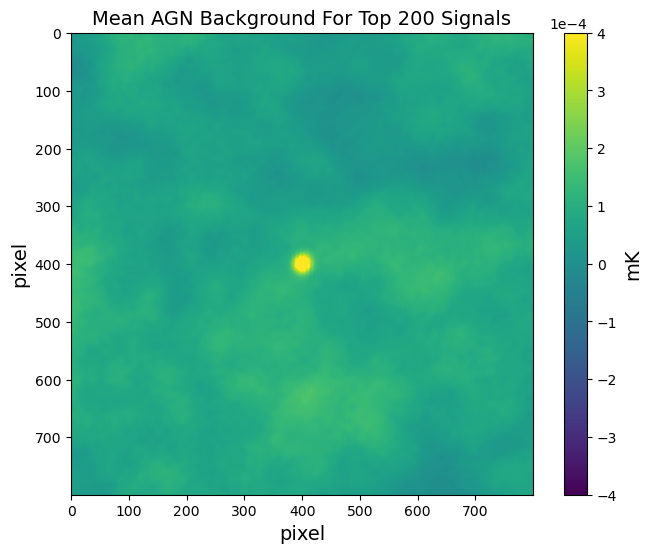 How does the AGN feedback effect change the shape of the total matter distribution in galaxies and
galaxy clusters? To understand the impact of this AGN feedback effect, we must first understand where they are located.
One question we have is how often do we find AGNs in a cluster or galaxy sample that we are interested in?
How does the AGN feedback effect change the shape of the total matter distribution in galaxies and
galaxy clusters? To understand the impact of this AGN feedback effect, we must first understand where they are located.
One question we have is how often do we find AGNs in a cluster or galaxy sample that we are interested in?
Science Education.
I'm continuously developing educational resources. I like to experiment with different forms of exposition and visualization.
View AllPlanetarium with Interstellar Positional Astronomy (PIPA)
Have you ever wondered what the night sky from other stars would look like? And what does the Sun look like from another star? I created a program that does just that. PIPA (Planetarium with Interstellar Positional Astronomy) is a free open source planetarium program based entirely on Python3. It uses the astrometric data from the High Precision PARallax COllecting Satellite (Hipparcos) mission to show in 3D what the sky from other stars would look like.
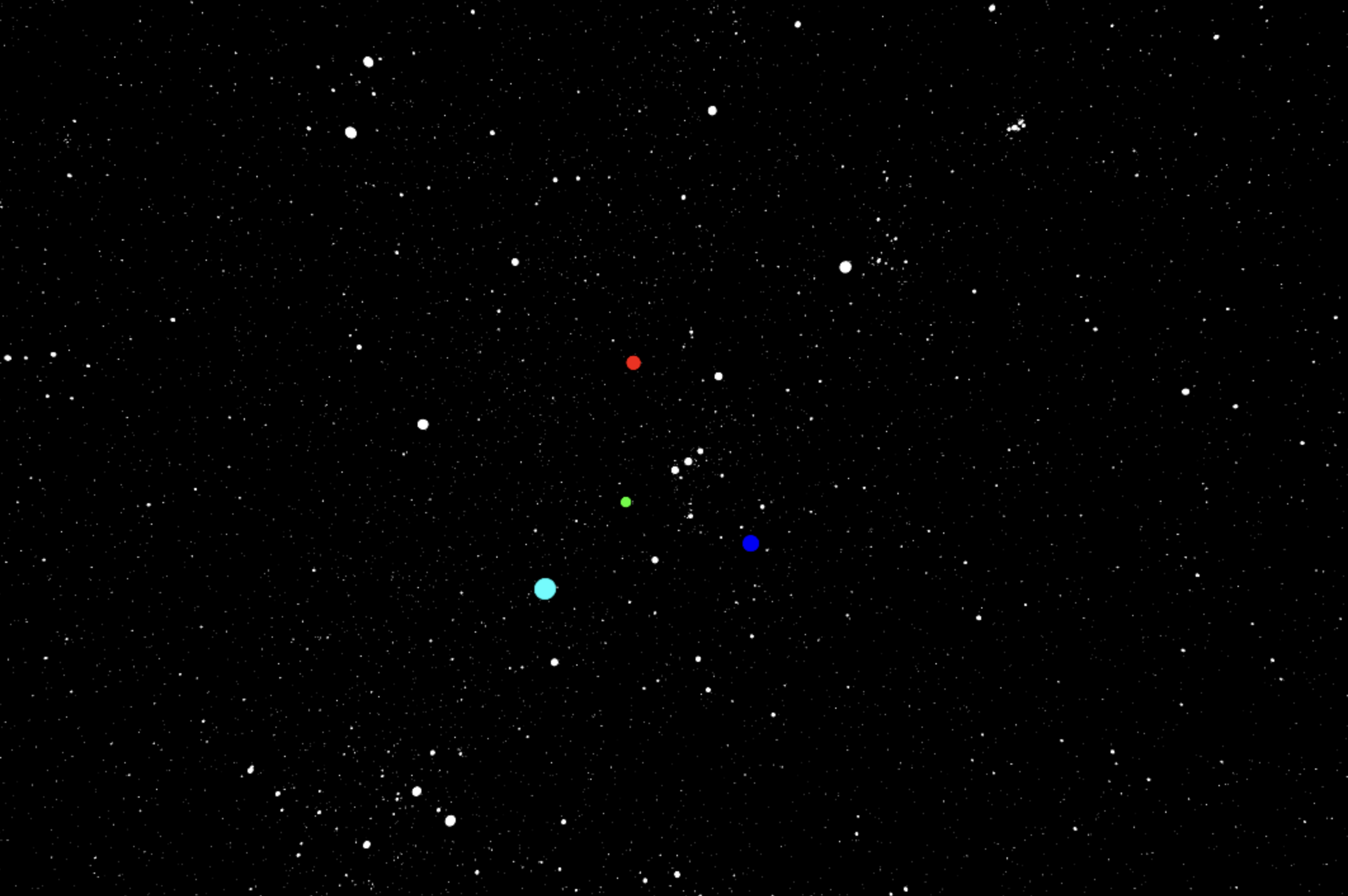
From Barnard's Star (HIP 87937) the Sun, shown in green, is in Orion. Sirius, shown in light blue, is shifted closer to Orion but still belongs to Canis Major. Betelgeuse is shown in red and Rigel is shown in blue.
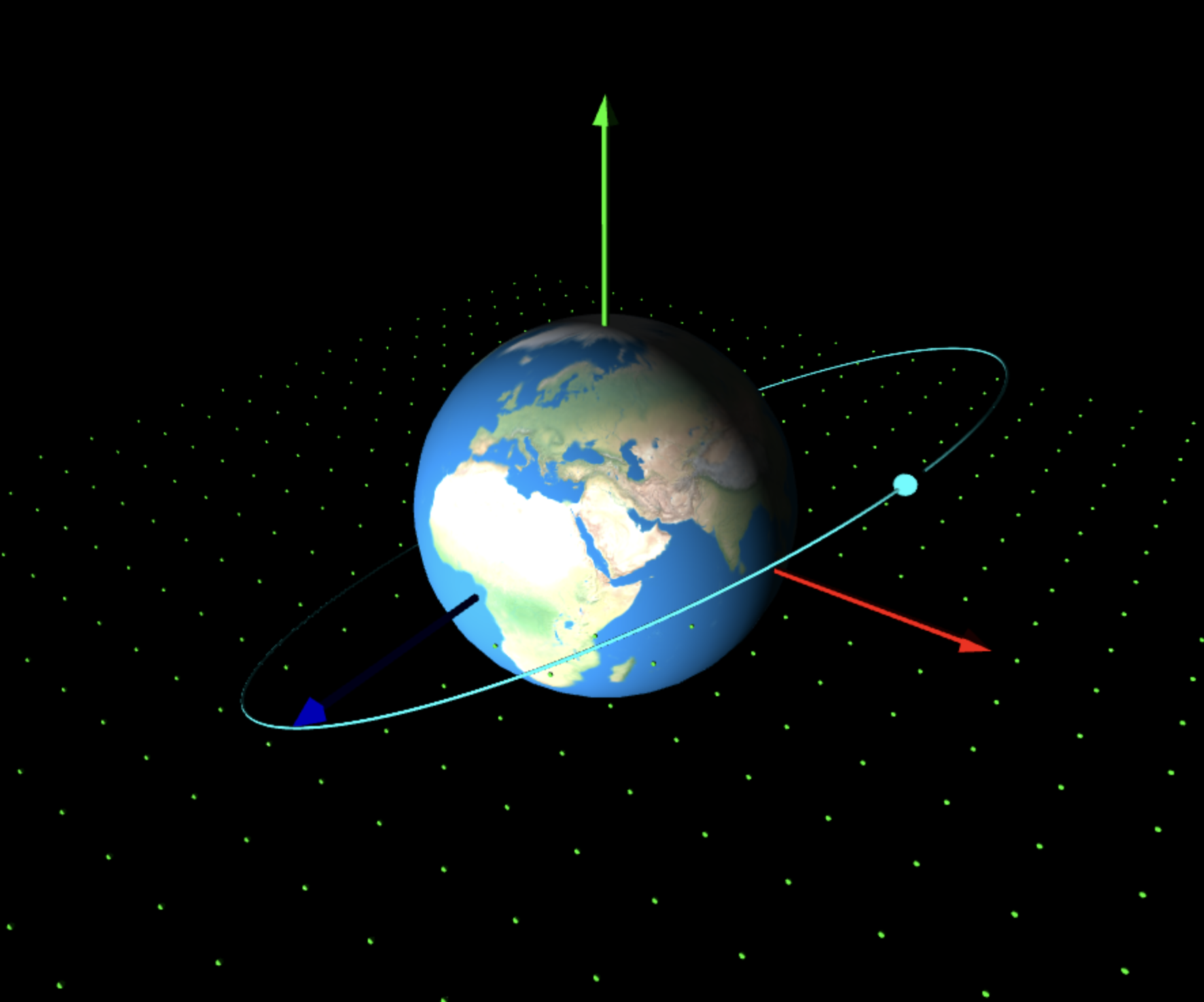
Orbital Elements
I wrote this code to help me and other students visualize what real orbits really look like. All so often we see orbits displayed in a 2D plane that it is easy to forget that real orbits are tridimensional. And so when we start talking about things like the argument of periapsis or the longitude of the ascending node, students tend to be confused. Another motivation behind this code was to have a convenient way to compute the orbit of a satellite from a single observation of its position and velocity.
Book: Astronomia Olimpica
The book Astronomia Olimpica was created to remedy the lack of affordable study materials available to Brazilian students, and to serve as a guide for those students interested in participating in astronomy competitions. With over 490 pages, the 7 chapters of the book cover the main theoretical contents of astronomy olympiads, such as positional astronomy, celestial mechanics, and others. Additionally, the book contains over 100 solved problems with comments from national and international astronomy medalists.
Something I really love about astronomy olympiads in general is how it preserves human knowlege. Nowadays, no one needs to calculate the duration of a solar eclipse, or be able to determine their position at sea using spherical trignometry. And understandably so, those are not easy problems. But every so often a high school student is asked those questions, which exposes them to some of the oldest and most important branches of astronomy and mathematics.